
When you start looking for ways to invest your money, you will come across many options. IPOs and mutual funds are two of them.
At first, they may look quite similar because both are connected with the market. But the way they work is very different.

In an IPO, you apply to buy shares of a l fund, your money goes into a fund along with money from other investors. The fund then invests that money in different securities.
If you are new to investing, this difference can be confusing. So, let’s understand IPOs and mutual funds without using complicated financial terms.
What exactly is an IPO?

IPO stands for Initial Public Offering.
Before an IPO, a company is privately owned. When the company decides to raise money from the public by selling shares, it brings an IPO.
You can apply for shares during the IPO period. But applying does not mean that you will definitely receive the shares.
For instance, suppose you apply for 100 shares. If the IPO receives applications from many more investors than the number of shares available, you may receive fewer shares or none at all.
If you get the shares, they are credited to your demat account. After the company is listed on the stock exchange, the share price can move up or down depending on market conditions and how investors view the company.
So, in simple terms, an IPO means buying shares of a particular company when it comes to the public market.
And what is a mutual fund?
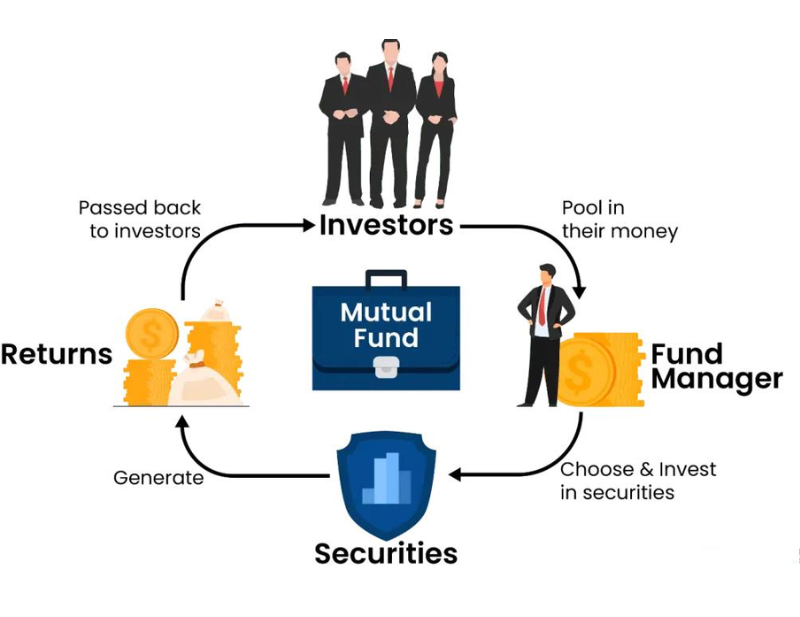
A mutual fund works in a different way.
Instead of choosing and buying shares of a company yourself, you invest in a mutual fund scheme. Many investors put their money into the scheme, and that money is invested according to the fund’s objective.
An equity mutual fund, for example, may invest in shares of several companies.
You don’t have to personally buy each of those shares. The fund manager handles the portfolio and makes investment decisions based on the fund’s strategy.
Mutual funds also give you the option of investing regularly through a SIP. You can invest a fixed amount at regular intervals instead of putting in a large amount all at once.
IPO vs Mutual Fund: where does your money go?
This is probably the easiest way to understand the difference.
When you apply for an IPO, your money is going towards shares of one particular company.
When you invest in a mutual fund, your money is invested in a portfolio of investments, depending on the type of fund.
For example, if you buy shares through an IPO, the performance of that company matters directly to your investment.
With a mutual fund, the fund may hold shares of many companies. Therefore, the performance of your investment is linked to the overall portfolio rather than just one company.
Of course, every mutual fund is different, so the level of diversification also depends on the scheme.
Is one more risky than the other?
There is no simple answer because risk depends on what you invest in and how the investment behaves.
With an IPO, you are generally putting your money into one company. If that company’s share price falls after listing, your investment can fall too.
A mutual fund can spread money across several investments. This can reduce the dependence on a single company, although it does not remove market risk.
For example, an equity mutual fund can still fall when the stock market goes through a difficult period.
So don’t think of mutual funds as risk-free investments. They are market-linked investments, and their value can go up and down.
What about returns?
This is another area where investors sometimes get the wrong idea.
There is no guaranteed return from an IPO.
An IPO may be listed above its issue price, around the issue price, or below it. The market decides the share price after listing.
The same applies to mutual funds. Their returns are not fixed. They depend on the investments held by the fund and how those investments perform.
You may see a mutual fund with strong returns over the past few years. But that does not mean the same return will continue in the future.
Looking at returns is useful, but it should not be the only thing you look at.
SIP makes mutual fund investing different

One of the biggest differences is the way you can invest in a mutual fund.
You can start a SIP and invest a fixed amount regularly.
Let’s say you want to invest every month. Instead of waiting for the “perfect” time to invest, you can continue investing according to your SIP plan.
An IPO doesn’t work like that.
You can apply only when a company launches its IPO. Once the IPO period ends, you cannot keep putting money into that same public issue every month.
This is one reason why mutual funds are often considered by people who want to build a regular investment habit.
Which one requires more research?
If you are thinking about an IPO, you need to understand the company.
What does it sell? How does it make money? How has the business been performing? What are its debts? Why is it raising money? What are the risks?
These are some of the questions worth asking before applying.
With a mutual fund, your research is more about the scheme.
You can look at its investment objective, portfolio, risk level, costs, fund manager and how it has performed over different periods.
In both cases, simply following what your friends, social media influencers or someone in a WhatsApp group is doing can be risky.
Understanding the investment yourself is important.
Can a beginner invest in an IPO?
Yes, a beginner can apply for an IPO.
But being able to apply and understanding what you are investing in are two different things.
If you are new to the stock market, take some time to understand the company and the risks before applying.
Don’t apply only because an IPO is getting a lot of attention or because someone says that it will give a quick profit.
There is no certainty about how a newly listed share will perform.
What about beginners and mutual funds?
Mutual funds can also be considered by people who are starting their investment journey.
There are different types of mutual funds for different investment needs and risk levels.
Some investors choose SIPs because they want to invest regularly without worrying about putting a large amount in at one time.
But even here, the fund should be selected carefully. A mutual fund should not be chosen just because its recent return looks attractive.
Your goal and time period matter too.
Can an investor use both?
Yes, an investor can have both IPO investments and mutual fund investments.
They don’t have to be treated as competing choices.
Someone may want to invest in a company directly and also have mutual funds for diversification. Another person may prefer to keep things simple and invest mainly through mutual funds.
It depends on the person’s financial goals, knowledge, risk comfort and overall investment plan.
There is no rule saying that every investor should choose the same option.
What should you ask yourself before choosing?
Before putting your money anywhere, stop for a moment and ask yourself a few basic questions.
Why am I investing?
Knowing your goal gives you a starting point.
When will I need this money?
An investment meant for a short-term need may require a different approach from money being invested for a long-term goal.
How much market fluctuation can I handle?
Prices can fall. This is part of market investing. You should know how comfortable you are with that.
And finally:
Do I understand what I am investing in?
If the answer is no, spend some time learning before you invest.
The bottom line
IPO and mutual funds are not the same investment.
An IPO gives you an opportunity to buy shares of a company when it offers them to the public. A mutual fund gives you access to a portfolio that is managed according to a particular investment objective.
Both have their own risks and features.
Instead of asking which one is “better”, first think about what you actually need from your investment.
If you want to invest directly in a particular company, an IPO may be something you choose to research.
If you prefer a managed portfolio and want the option of investing regularly through a SIP, mutual funds may be worth exploring.
Whatever you choose, don’t invest just because something is popular at the moment. Understand the product, know your goal and consider the risk before putting your money into it.
That simple habit can make your investment decisions much more thoughtful.